Safety & Care Guide
Comprehensive e-stim safety, usage instructions, contraindications, and maintenance guidelines for electrical stimulation devices.
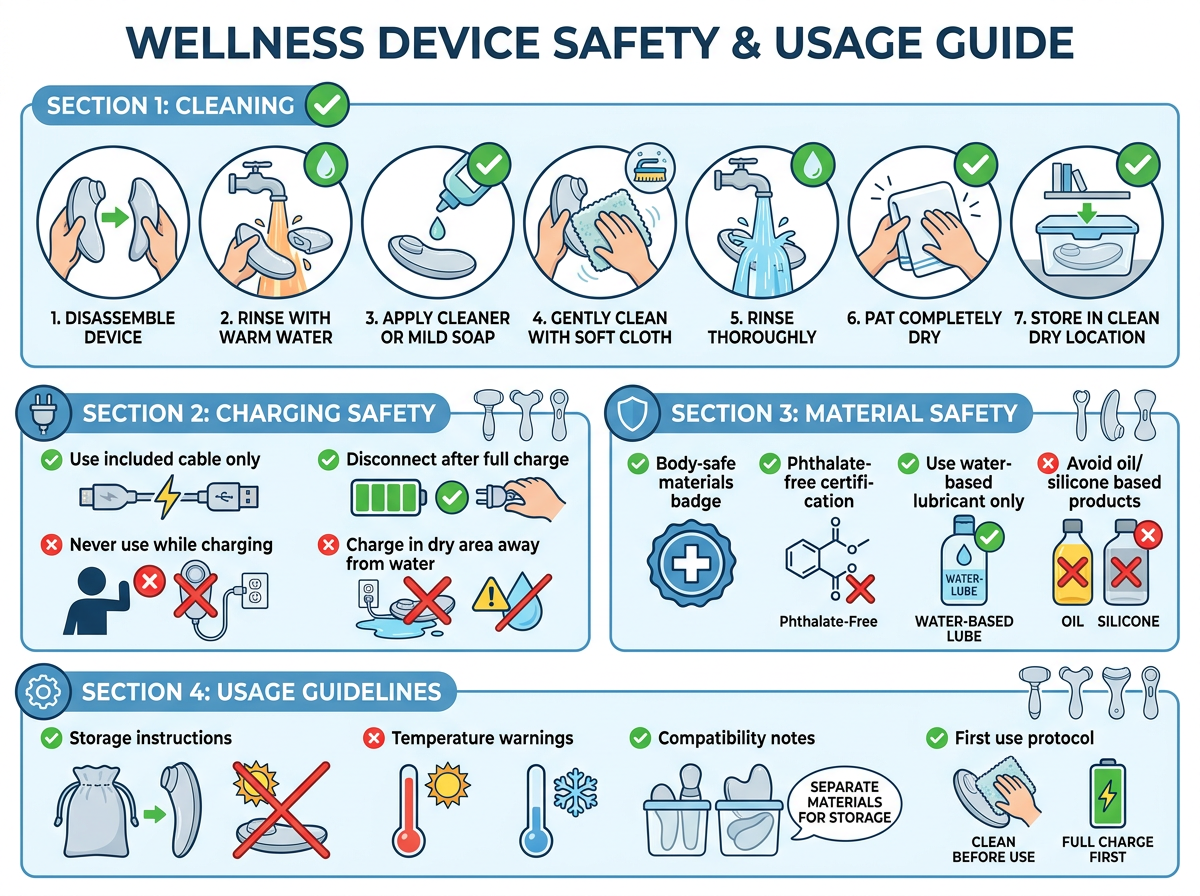
Cleaning Guide
Follow these 7 steps for proper cleaning and hygiene.
Disassemble Device
Remove any detachable sleeves or covers carefully.
Rinse with Warm Water
Use lukewarm water to remove surface residue.
Apply Cleaner
Use mild, unscented soap or dedicated toy cleaner.
Gently Clean
Use a soft cloth to clean all surfaces thoroughly.
Rinse Thoroughly
Remove all soap residue under clean running water.
Pat Dry
Dry completely with a lint-free cloth.
Store Properly
Place in a clean, dry storage pouch or original box.
Safety Guidelines
Do's
- Use water-based lubricant only (essential for e-stim conductivity)
- Clean before first use and after every use
- Fully charge before first use
- Start e-stim at lowest intensity — increase gradually
- Allow 30 seconds between e-stim intensity increases
- Disconnect charging before use
- Check electrodes for damage before each use
- Use in a comfortable, relaxed position
- Keep first e-stim session under 20 minutes
- Follow manufacturer charging guidelines
Don'ts
- Use oil-based or silicone lubricant
- Use e-stim while charging (galvanic isolation risk)
- Use e-stim with dry electrodes (causes stinging)
- Use if you have a pacemaker or implanted defibrillator
- Use during pregnancy
- Use on broken skin or active infections
- Use if device or electrodes show visible damage
- Use e-stim with numbing lubricants (need full sensation for safety)
- Submerge beyond IPX7 rating limits
- Use incompatible chargers
Safety Certifications
Both products meet or exceed these industry standards.
RoHS 2011/65/EU
Free from hazardous substances including lead, mercury, cadmium, and hexavalent chromium per EU directive.
IEC 60601-2-10 Class II
Medical-device safety standard for nerve & muscle stimulators. All e-stim output circuits tested for maximum current, charge-per-phase, and charge density limits.
ISO 10993-5 Cytotoxicity
Biological evaluation of medical-device materials. All electrode and body-contact surfaces passed L929 fibroblast cytotoxicity assay.
Phthalate-Free / BPA-Free
Platinum-cure medical-grade silicone — free of phthalates, BPA, and latex. Biocompatible for prolonged mucosal contact.
ISO 3533:2021
International standard for design, safety, and manufacturing requirements of products intended for intimate use.
FCC Part 15B / EN 55032
Bluetooth 5.0 and e-stim pulse circuits comply with EMC radiated & conducted emission limits.
IEC 60529 IPX7
Ingress protection rated — submersible to 1 m for 30 min. E-stim auto-disables via impedance-sensing when submerged.
CE Marking (EU 2023/1230)
Conforms to the EU Machinery Regulation for consumer product safety, EMC, and RoHS compliance.
Charging & Power Safety
Use Included Cable Only
Always use the manufacturer-provided USB-C charging cable to prevent damage.
Disconnect After Full Charge
Unplug the device once fully charged to preserve battery longevity.
Never Use While Charging
Always disconnect the charging cable before using the device.
Charge in Dry Area
Despite IPX7 rating, always charge devices in a dry environment away from water.
E-Stim Contraindications
Important: Do NOT use electrical stimulation modes if any of the following conditions apply.
Cardiac Pacemaker / Defibrillator
Electrical pulses may interfere with implanted cardiac device function, potentially causing arrhythmia.
Epilepsy
Electrical stimulation near the spinal cord may lower seizure threshold in susceptible individuals.
Pregnancy
Effects of electrical stimulation on fetal development are unknown. Pelvic e-stim may trigger uterine contractions.
Metal Implants (Pelvic Region)
Metal implants can concentrate electrical current, causing localized heating and tissue damage.
Peripheral Neuropathy
Reduced sensation means you cannot gauge intensity safely — risk of overstimulation without awareness.
Active Skin Conditions
Open wounds, rashes, or infections at electrode contact sites increase infection risk and cause pain.
Under Influence of Alcohol/Drugs
Impaired sensation and judgment prevent safe intensity management.
When in Doubt, Consult Your Physician
If you have any cardiovascular, neurological, or dermatological conditions, consult your healthcare provider before using electrical stimulation features. Vibration-only modes can be used as a safe alternative.
Frequently Asked Questions
Regulatory Disclaimer
These products are consumer wellness devices, NOT medical devices. They have not been evaluated or cleared by the U.S. Food & Drug Administration (FDA), Health Canada, or the EU Medical Device Regulation (MDR 2017/745) for the diagnosis, treatment, cure, or prevention of any disease or medical condition.
IEC 60601-2-10 testing is referenced as a voluntary safety benchmark for e-stim output limits — it does not imply medical-device classification. ISO 10993-5 cytotoxicity testing was performed on body-contact materials only and does not constitute clinical biocompatibility certification.
Individuals with implanted electronic devices (pacemakers, defibrillators, insulin pumps), epilepsy, pregnancy, or active infections should NOT use electrical stimulation modes. Always consult a qualified healthcare professional before use if you have any pre-existing medical conditions.