Red-Wave Pro
Automatic Male Stroker with Electrostimulation (EMS/TENS)
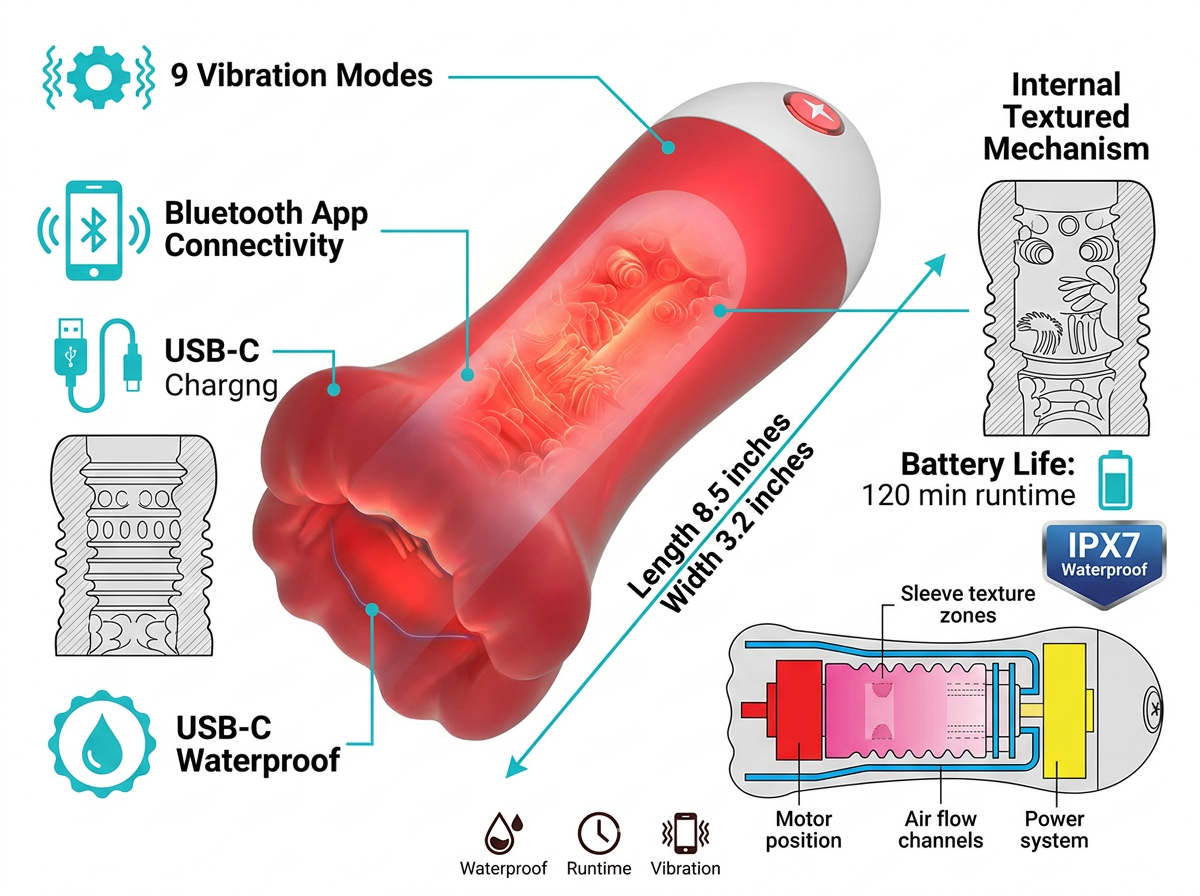
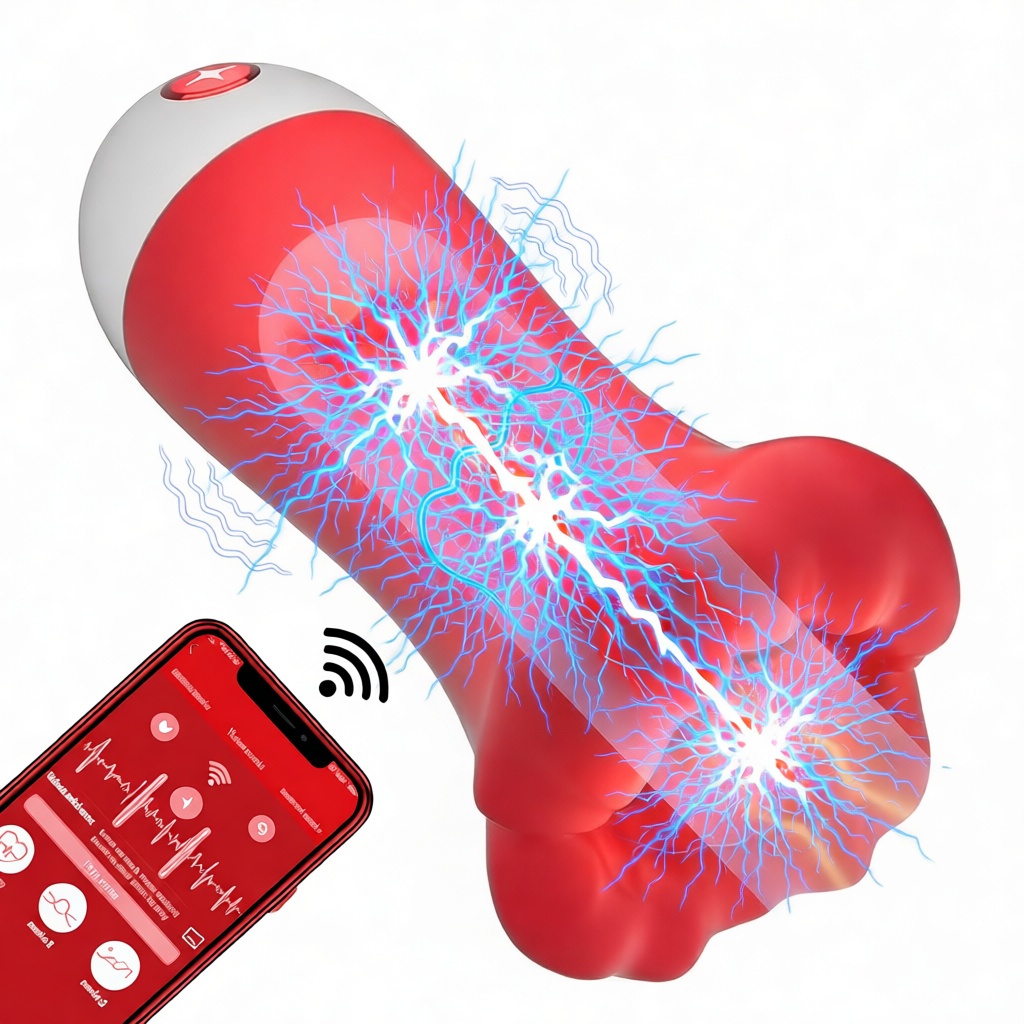
The Red-Wave Pro integrates traditional vibration with transcutaneous electrical nerve stimulation (TENS). The device uses medical-grade biphasic waveforms (symmetric charge-balanced pulses) delivered through gold-plated surface electrodes embedded in a TPE sleeve. Current output is hardware-limited to 15 mA per IEC 60601-2-10 Class II requirements, with automatic impedance monitoring that disables output if skin contact is lost. The 2,500 mAh lithium-polymer cell provides up to 90 minutes of combined vibration + e-stim use. Bluetooth 5.0 LE enables companion-app pattern control with AES-128 encrypted connections.
Key Features
Engineered for performance, comfort, and safety.
9 Vibration Patterns
Eccentric rotating mass (ERM) motor delivers 9 preset patterns — constant, escalating, pulse, wave, and randomised — targeting Meissner corpuscles (light touch, 10–50 Hz) and Pacinian corpuscles (deep pressure, 60–300 Hz).
TENS Electrostimulation (5 Levels)
Five calibrated intensity steps from 0.5 mA (sub-threshold tingling) to 15 mA (strong contraction). Biphasic symmetric pulses at 2–150 Hz with 50–300 µs pulse width ensure zero net charge delivery, preventing electrolytic tissue damage per IEC 60601-2-10.
Bluetooth 5.0 LE App Control
Companion app (iOS 14+/Android 10+) communicates via BLE with AES-128 encryption. Features: real-time intensity curves, custom waveform editor (pulse width, frequency, duty cycle), pattern library, and encrypted partner sharing with <80 ms round-trip latency.
USB-C Charging (2,500 mAh)
Lithium-polymer cell with CC/CV charging profile and integrated BMS: over-voltage (4.2 V), under-voltage (2.8 V), over-current (2 A), and thermal (0–45 °C) protection. 500+ cycle lifespan to 80% capacity. Full charge: ~75 min at 5 V/2 A.
Gold-Plated Cu Electrodes in TPE
Three electrode zones embedded in medical-grade TPE (Shore A 10). Gold plating (0.5 µm over 99.9% Cu) provides <5 Ω contact impedance, corrosion resistance, and biocompatibility. Electrode spacing optimised at 8–12 mm for effective current density without deep-tissue penetration.
IPX7 Sealed Housing
Double O-ring sealed electrode chamber + ultrasonic-welded ABS shell. Immersible to 1 m / 30 min per IEC 60529. Integrated conductivity sensor auto-disables e-stim when full submersion is detected to prevent current dispersion through water.
Spring-Loaded Shock Absorber
15 mm travel vertical spring dampener maintains 0.5–1.5 N/cm² electrode contact pressure during movement. Eliminates intermittent contact (micro-arcing) that causes stinging — essential for comfortable e-stim at higher intensities.
Whisper-Quiet Operation
Brushless DC motor with silicone isolation gaskets: <50 dB at maximum vibration. E-stim circuitry is entirely silent — zero acoustic output during electrical-only stimulation modes.
Electrical Stimulation Modes
Charge-balanced biphasic symmetric TENS waveforms across 5 intensity levels (0.5–15 mA) and 4 stimulation patterns. Combined with 9 vibration modes for 180 total mode permutations.
Intensity Levels
Stimulation Patterns
Continuous
Steady-state current at selected intensity for sustained nerve activation
Pulse
Rhythmic on/off at 2–10Hz — slow endorphin-mediated response via C-fiber activation
Burst
Rapid 3–5 pulse trains at 80Hz with 1s gaps — mimics natural neuromuscular firing
Modulated
Sweeping 2Hz→150Hz wave — sequential recruitment of C-fibers then A-delta fibers
The Science Behind E-Stim
Gate Control Theory
Electrical pulses activate large-diameter A-beta fibers that trigger inhibitory interneurons in the spinal cord dorsal horn (Melzack & Wall, 1965). These release GABA and glycine, modulating the sensory "gate" in the substantia gelatinosa to amplify pleasurable tactile input.
Nerve Fiber Recruitment
At 2–10Hz: C-fibers are activated, releasing endorphins and enkephalins for slow, diffuse euphoria. At 80–150Hz: A-delta fibers engage for sharp, fast-conducting sensations (5–30 m/s). Our biphasic waveform crosses the depolarization threshold of sensory neurons at precisely controlled charge densities.
Endorphin Cascade
Low-frequency TENS (2–10Hz) triggers the release of β-endorphin and met-enkephalin from the periaqueductal gray (PAG) and nucleus raphe magnus. These endogenous opioids bind to μ-opioid receptors, producing the natural "reward" sensation.
Electrode Biophysics
Gold-plated copper electrodes (0.5μm Au layer) offer impedance <5Ω at skin contact, ensuring efficient current transfer. The 3 electrode zones create a precisely shaped electric field that concentrates current density at mechanoreceptor-rich tissue regions.
Technical Specifications
Technical Breakdown
Detailed engineering diagram with key specifications highlighted.